The platform you choose has almost nothing to do with whether you'll make good money as a freelance healthcare content writer. I've worked through the big open marketplaces, the vetted ones, and the small niche communities. What separates the writers who do well isn't the website they picked but how they position themselves once they're on it. The platforms below are genuinely worth your time. Picking one is just the easy part.
TL;DR Quick Answers
Freelance healthcare content writer
A freelance healthcare content writer is an independent writer who turns complex medical information into clear, accurate content that patients can understand and act on. They work with clinics, private practices, and health brands, usually producing:
Patient education pages and health blog posts
Website and service-page copy
Explainer articles that make hard medical topics simple
The best ones earn their rate on judgment, not credentials. Healthcare clients hire for accuracy and lower risk: a writer who gets the clinical detail right, sources every claim, and keeps the content compliant. Done well, this is the work that helps a health business rank on Google and turn searchers into booked patients.
Top Takeaways
If you skim nothing else, take these with you.
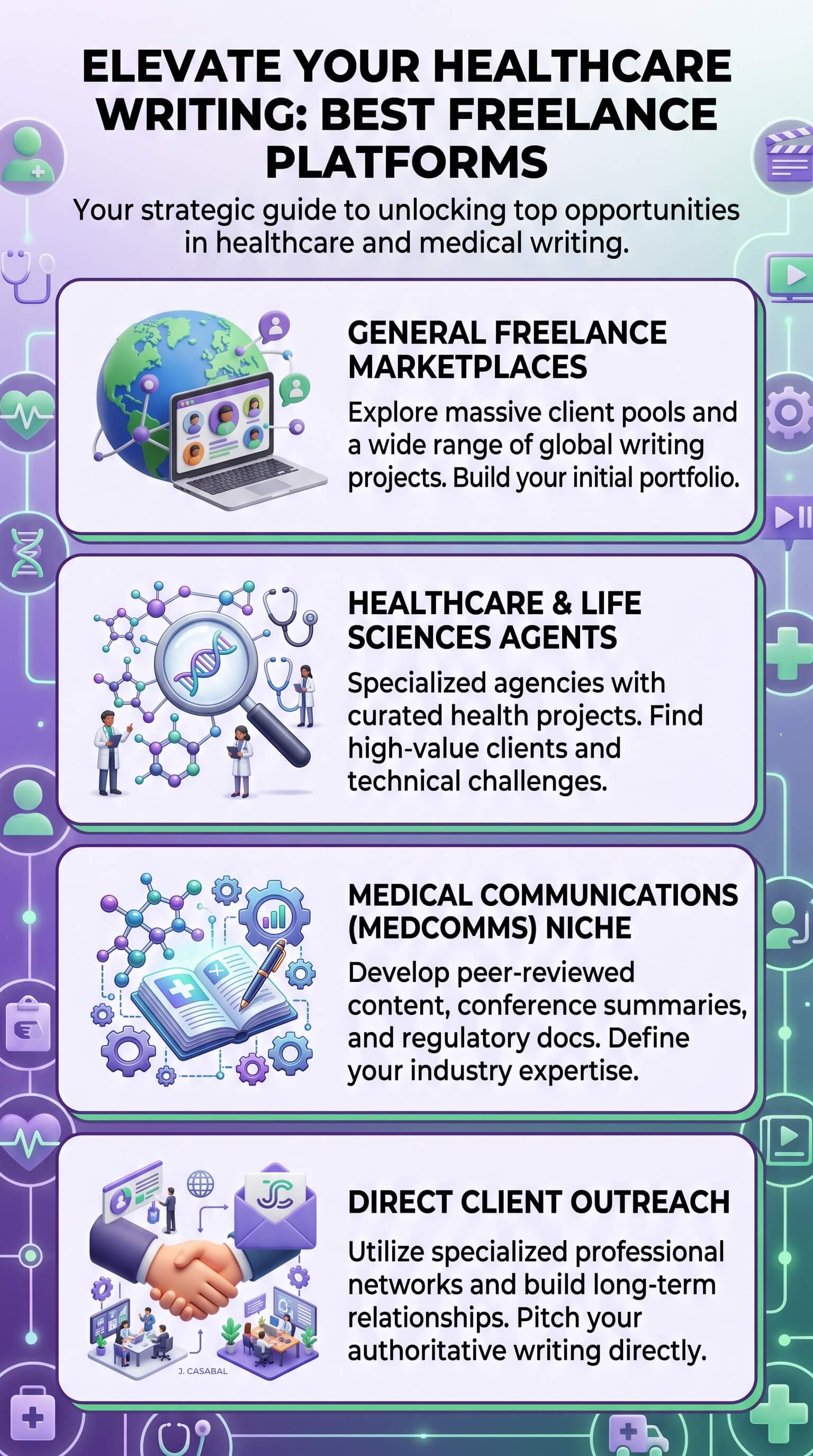
Healthcare writing work comes from four places: open marketplaces, managed content services, professional communities and job boards, and direct outreach. Most writers who make it use a mix of them.
Judge a platform by its rate floor, the quality of its clients, its payment protection, and how easily it leads to repeat work, not by how big its name is.
Regulated medical writing rarely shows up on open marketplaces. For clinical and regulatory work, start with the American Medical Writers Association.
Positioning beats platform choice every time. One of the quickest ways to sharpen your own pitch is to study how an established freelance healthcare content writer presents their specialism and services to clients.
The basics don't change with the platform. The habits of any solid website content writer, clear structure, honest sourcing, and straight communication, carry every health project you take.
What Every Freelance Healthcare Content Writer Should Look For in a Platform
Every place that hires health writers falls into one of four buckets: open marketplaces where clients post jobs and writers bid, managed content services that match you to clients and handle the admin, professional communities with job boards, and plain old direct outreach to brands and agencies. None of these is the best one. The right mix comes down to your experience, your niche, and how much selling you want to do yourself.
Signs a platform is worth your time
Before you build a profile anywhere, run it past four questions. Does it set a rate floor or minimum project price? Platforms without one race writers to the bottom, and that's a race you lose by entering. Next, look at whether healthcare and medical clients are genuinely posting work, or whether healthcare is just a category label with nothing behind it. Check that the platform protects your payment so you're not chasing invoices later. And ask the question that matters most: does it make repeat work easy? One-off gigs keep you busy. Repeat clients keep you paid.
Match the platform to your healthcare niche
Healthcare writing isn't one job, so don't treat every platform the same. Patient education and health blog content move well on general marketplaces and managed services, including agencies that specialize in medical healthcare copywriting services, where the volume stays steady. SEO-focused health content does best on content marketplaces and through agency relationships. Regulated medical writing, the clinical and regulatory work, barely shows up on open marketplaces at all. That work travels through professional associations, specialist recruiters, and referrals. Pick the platforms that match the work you actually want, and you'll stop losing hours to jobs that were never a fit.

"Early on, I treated every marketplace like a place to move into. Profile set up, settled in, waiting for the work to find me. That was my mistake. A marketplace is a starting line, not an address. It's where you land your first few clients, prove you can handle medical topics without creating problems, and learn what buyers will actually pay for. The real work is positioning. Healthcare clients care less about your prose than about their own exposure. They want a writer who gets the clinical detail right, sources every claim, and won't hand their compliance team a headache. Build your whole pitch around that, and you stop competing on price. After that, the logo above the job post barely matters. So pick one or two platforms, go deep, and become the writer a health brand trusts with its hardest topics."
7 Essential Resources
These seven are where I'd actually look for healthcare writing work. Each one fits a different stage and style of freelancing, so read them with your own niche in mind.
Upwork. The biggest open marketplace, and the fastest way to build a track record from nothing. Healthcare and medical gigs show up in real volume. The catch is the crowding at the entry level. Use it to stack up reviews and samples, then push your rates up as your profile gets stronger.
Contra. Commission-free, and built around your portfolio instead of a bidding war. It suits mid-level and experienced writers who already have healthcare samples and want to keep every dollar they earn. The client pool is smaller than Upwork's, but the work tends to be better.
Scripted. A vetted content marketplace with a healthcare category of its own. You apply, get approved, then pitch clients at prices protected by minimums. A good fit if you pitch well and want steady content marketing work.
nDash. Here writers pitch content ideas straight to brands, and there's a section for health and wellness. It rewards writers who think like strategists rather than order-takers. Fair warning: you'll write pitches that don't land.
American Medical Writers Association. The largest professional association for medical communicators. Its Jobs Online board and open Freelance Directory point you toward clinical, regulatory, and scientific work you won't find on open marketplaces. Membership also buys you training and credibility.
Health Writer Hub. Training and career resources built specifically for health and medical writers. This is where you sharpen the craft, learn to write health content responsibly, and build the portfolio that makes every other platform on this list work.
Superpath. A content marketing community with an active job board and freelance gig listings. Health and wellness roles come up often, and the Slack community is one of the better places to hear about work before it ever gets posted.
Supporting Statistics
If you're still weighing whether healthcare is worth specializing in… three numbers settle it.
The global medical writing market is on track to grow from USD 3.94 billion in 2025 to USD 6.38 billion by 2030, a yearly growth rate of about 10 percent, according to Mordor Intelligence. Demand for skilled health content is climbing, not fading.
Writers and authors in the US earned a median wage of $72,270 in May 2024, and the field is projected to keep growing through 2034, according to the U.S. Bureau of Labor Statistics. Healthcare specialists usually land well above that median.
Freelance medical writers commonly charge between $60 and $150 an hour, based on a 2026 analysis of freelance writing statistics pulled from several writer surveys. What moves you into that range is niche expertise, not the years you've logged on any platform
Final Thoughts
If I were starting over tomorrow, I wouldn't sign up for all seven of these at once. I'd pick two. One marketplace to bring in paying work fast, and one community or association to build skills and hear about the better opportunities. Signing up everywhere feels productive… but mostly it just spreads your effort too thin to matter.
My honest read on the market right now is that it's splitting in two. AI has wiped out demand for generic, low-effort health content, and that work is NOT coming back, including the kind of shallow material often mistaken for real board game copywriting services in niche marketing spaces. At the same time, clients want writers who genuinely understand medical topics and take accuracy seriously, and they're paying for it. That's good news, but only if you're willing to specialize. The writers struggling today are the generalists competing on price. The writers raising their rates picked a healthcare niche and got known for it. I'd choose the second path. I did, and it worked.
Frequently Asked Questions
What is the best freelance platform for healthcare writers?
There's no single best one. Upwork is the strongest place to start and build a track record. Contra suits experienced writers who want to keep their full rate. For clinical and regulatory work, the American Medical Writers Association beats any open marketplace. Your best platform depends on your niche and how far along you are.
Do you need medical credentials to write healthcare content?
For most patient education, health blog, and content marketing work, no. What matters more is solid research, careful sourcing, and samples that prove you handle medical topics responsibly. Clinical and regulatory writing is the exception, where clients usually expect a science or healthcare background.
How much can a freelance healthcare content writer earn?
It varies a lot by niche and experience. General health content pays at the lower end. Specialized medical writers commonly charge $60 to $150 an hour. Your niche and how you position yourself drive your income far more than how long you've used any one platform.
How do beginner healthcare writers find their first clients?
Start on a general marketplace like Upwork to collect reviews and samples, and join a community or association at the same time. Write two or three strong healthcare samples first, even unpaid ones, so your profile shows you can handle the subject before you pitch.
Are content mills worth it for healthcare writers?
Not for long. Content mills pay low flat rates and rarely turn into lasting client relationships. They can work as short-term practice and a way to build clips, but plan your exit toward direct clients and vetted platforms as soon as you can.
How is AI changing freelance healthcare writing?
AI has cut demand for generic, low-effort health content, and that work isn't coming back. Demand for writers who understand medical topics and take accuracy seriously is growing instead. Specialize in healthcare, and lead with your judgment and sourcing. That's how you stay hard to replace.
Ready to Land Better Healthcare Writing Clients?
Pick one marketplace and one community from the seven above, and set up your profile this week. Add two or three healthcare samples that show you treat medical topics with care. Then start pitching. The writers who get ahead aren't waiting around for a perfect platform. They chose a niche, showed up week after week, and made themselves easy to hire. Start today, and start specific.