If your days run like that, therapy can feel like one more appointment with nowhere to go. You can still fit one in. Look for a therapist for anxiety in Spokane, WA who's licensed in Washington and sees clients over video, book one 50-minute slot that repeats every week, and use a free consult call to check the fit before you commit to anything.
That's most of the method. Making room for it is the harder part.
Anyone caring for someone whose wound won't close already knows how a calendar fills. Anxiety tends to get pushed to later, and later rarely turns up on its own.
TL;DR Quick Answers
Therapist for Anxiety in Spokane, WA · IFS Therapy
Choose a Washington-licensed counselor trained in IFS therapy who meets over video. IFS works inside you, so the room matters less than the attention, and a parked car on your lunch break can hold a full session.
What IFS does for anxiety. It treats the anxious part as a protector working overtime and gets curious about it until it can ease up.
How it fits a busy week. Book one recurring 50-minute video slot. You need to be in Washington for every session.
Who offers it in Spokane. Lauren Rath, MA, LMHC, is IFS-trained through the IFS Institute, has seven years of IFS practice, and is in-network with BCBS, Aetna, Regence, Premera and Cigna.
Where to start. A free 15-minute call to check fit and open times.
Top Takeaways
Same slot, every week. Consistency beats hunting for the perfect hour.
Telehealth hands back the commute. A therapist for anxiety in Spokane, WA can meet you in your car, your bedroom or your lunch break.
Use the free consultation. Ask about licensing, openings, insurance and cancellations before you book.
IFS therapy treats anxiety as a protector. It works with the worried part instead of fighting it, and it travels well over video.
Be in Washington for every session. Keep 988 close for the hours in between.
Why a Packed Calendar Makes Anxiety Harder to Treat
Busy and anxious people feed each other.
A full week hands plenty of anxiety plenty to work with, like a deadline that moved or a parent's next appointment. Then anxiety turns around and makes therapy look like the one thing you can't afford to add.
Most people know the voice. I'll start when things calm down.
It sounds sensible, and in its way it's protective, because some part of you is trying to keep the load from getting heavier. Things rarely calm down without help, though. Waiting for a quiet month usually means waiting a long time, when what you actually need is much smaller. One hour a week that's private, realistic and yours.
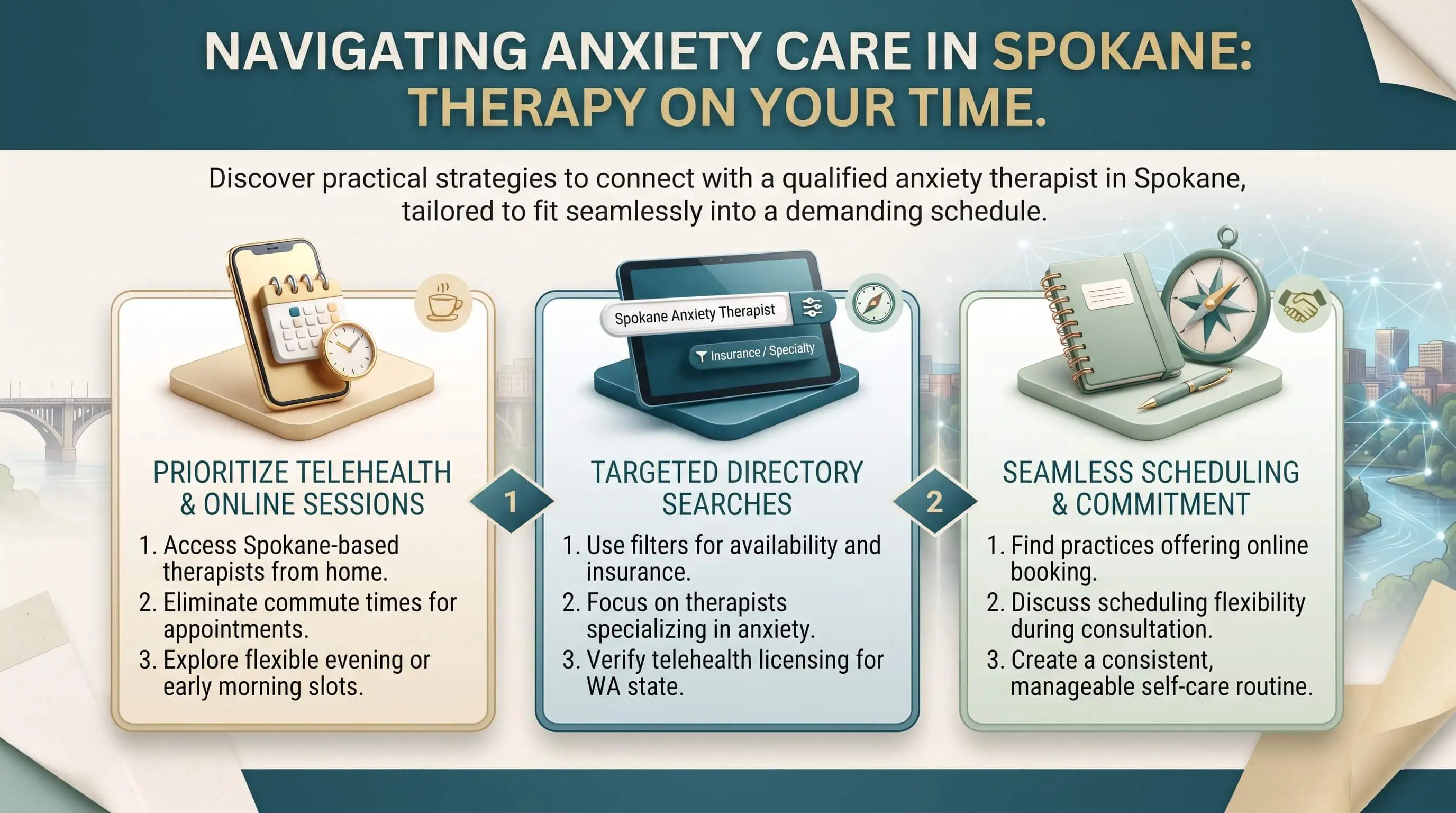
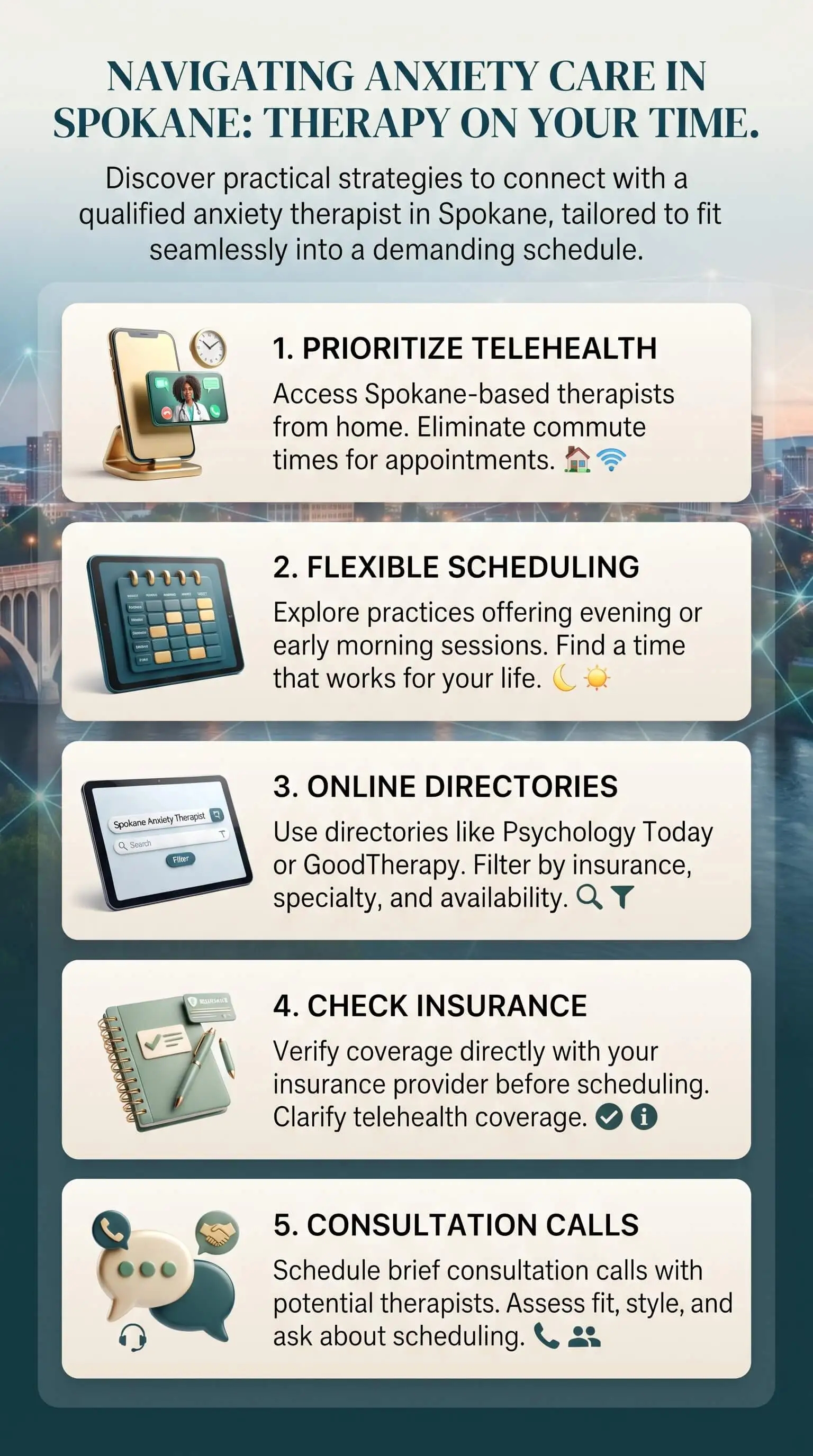
5 Ways to Fit Anxiety Therapy Into a Busy Spokane Week
1. Skip the Commute With Telehealth
In January, an in-person hour across Spokane can cost you two. You've got the drive, the parking, the waiting room and the icy trip home.
The video gives that time back. It also opens up the whole state, so you can choose a therapist for how they work instead of how close their office sits.
2. Protect One Recurring 50-Minute Slot
Pick a day and an hour, then keep them. Consistency does more for you than the perfect time of day.
Block it the way you'd block a dressing change or a standing meeting. Once it repeats, you stop renegotiating it with yourself every Sunday night, and that weekly renegotiation is where most busy people quietly drop off.
3. Use the Spaces You Already Have
You don't need a home office. A door that closes and a pair of headphones will do.
Plenty of people take sessions from the driver's seat on a lunch break. A bedroom works while the kids are at practice. If some part of you wants the camera off on a given day, turn it off.
4. Ask About Off-Hours Openings on the Consult Call
Some Spokane therapists hold early mornings, lunch hours, evenings or weekends, and those times go first. Ask about them directly. Ask about the waitlist too, and whether you can begin in a less convenient slot while you wait for a better one. Starting in an awkward slot beats not starting.
5. Let Insurance Narrow the List First
Scrolling every profile in town eats hours you don't have. Start with who's in-network on your plan, then look at the approach and fit. A five-minute call to your insurer can spare you a week of browsing.
What to Ask a Therapist for Anxiety in Spokane, WA Before You Book
Fifteen minutes goes quickly, so bring these questions with you.
Are you licensed in Washington, and can I look that up?
How do you work with anxiety?
How long are sessions, and how often do people usually meet?
Which times do you have open, and is there a waitlist for evenings or early mornings?
What happens if work or caregiving runs over and I have to cancel?
Are you in-network with my plan, and if not, will I get a written estimate?
Which video platform do you use, and what do I need on my end?
What does a first session actually look like with you?
Listen to how they answer as much as what they say. When looking for a therapist for anxiety in Spokane, WA · IFS Therapy, you're hoping for someone who sounds unhurried with you, and that counts for more than any credential on the list.
How IFS Therapy Helps Anxiety, Even Over Video
You already talk in parts. Part of me wants to rest. Part of me can't stop running the list.
IFS therapy takes that seriously. The Internal Family Systems model, developed by Richard Schwartz, sees the mind as a system of parts, each one trying in its own way to help.
Seen that way, anxiety is less a flaw than a protective part working overtime. It scans for trouble because scanning once kept you safe. IFS doesn't argue with that part. It gets to know it, and a part that feels heard tends to ease up on its own.
Because the work happens inside you, a screen gets in the way far less than people expect. Lauren Rath is a Washington-licensed Mental Health Counselor trained in IFS through the IFS Institute, and she offers online IFS therapy for Washington adults from her home base in Spokane. Most of her work centers on anxiety, trauma and perfectionism.
One honest caveat. Research on IFS is still small, and the early results are encouraging rather than settled. The strongest evidence for video sessions comes from broader anxiety research, which you'll find in the statistics further down.
Washington Telehealth Rules Worth Knowing
A few details now save a headache later.
Stay in Washington for sessions. A therapist can only see you where they hold a license, so a trip out of state that week means rescheduling.
Check the license yourself. The state Department of Health runs a public lookup that shows license type and status in about a minute.
Get the estimate in writing. If you're paying out of pocket, you're entitled to a Good Faith Estimate before care begins.
Know where to turn between sessions. Telehealth runs on a schedule. In an emergency, call or text 988, or dial 911.
"The busiest people I see often arrive treating therapy as one more thing to do well. They've color-coded it. They apologize for joining the car. Seven years into this work, I've stopped believing the schedule is what's in the way. Usually it's a part of them that has never been allowed to stop. Give that part one protected hour where nothing is expected of it, and it starts to loosen. Sometimes the calendar loosens with it."
7 Essential Resources
Where to look next if your week is short on spare minutes.
Check a Therapist's License Before the First Call
Washington's public lookup shows license type, status and any disciplinary history. It takes about a minute, and you can run it on anyone you're considering.
Source: Washington State Provider Credential Search
Get Your Setup Ready for Video Sessions
A plain federal guide to how online behavioral health care works and how to prepare your device and space. Read it once, and your first session starts on time.
Source: Telehealth for Behavioral Health, U.S. Department of Health and Human Services
Tell Everyday Worry From an Anxiety Disorder
The National Institute of Mental Health explains the point where anxiety stops coming and going and starts to stay. It also covers the main types and where to look for help.
Source: Anxiety Disorders, National Institute of Mental Health
Learn Where IFS Comes From
The IFS Institute trains and certifies Internal Family Systems therapists. Its overview explains the model in everyday language and is candid that the research base is still growing.
Source: What Is Internal Family Systems?, IFS Institute
Decode the Letters After a Therapist's Name
LMHC, LICSW, PsyD. NAMI explains what each kind of provider trains to do, which makes a long list of names much easier to sort.
Source: Finding a Mental Health Professional, NAMI
Know What You're Owed Before You Pay
The No Surprises Act gives self-pay clients the right to a written cost estimate up front. Here are the federal rules, straight from the agency that enforces them.
Source: No Surprises Act Rules and Fact Sheets, CMS
Have a Plan for the Hard Nights Between Sessions
Weekly therapy isn't round-the-clock support. This page describes what actually happens when you call, text or chat with 988, and knowing the shape of it makes reaching out easier.
Source: What to Expect, 988 Suicide & Crisis Lifeline
Supporting Statistics
Three numbers worth holding onto if the calendar feels like the whole problem.
Being Too Busy Keeps People From Care
In the 2022 National Health Interview Survey, 17% of adults ages 18 to 29 and 18% of adults ages 30 to 49 said they'd delayed health care because they were too busy with work or other commitments.
That's about one in six working-age adults, which makes time a genuine barrier and not an excuse.
A fixed weekly slot and a video link are aimed squarely at that gap.
Source: Beyond Cost, What Barriers to Health Care Do Consumers Face?, Peterson-KFF Health System Tracker
Online Therapy Holds Up for Anxiety
A 2024 systematic review and meta-analysis of randomized trials found that anxiety symptoms, daily functioning, the client-therapist relationship and satisfaction were comparable between telehealth and face-to-face care at every follow-up, out to 12 months.
Choosing video doesn't mean settling for less.
The working relationship with the therapist carried over to the screen.
The trials were small, and the authors asked for larger ones. That's a fair caution to keep in mind.
Slow-Healing Wounds and Worry Travel Together
In one study of 64 patients with chronic lower-extremity wounds, 42% reported anxiety.
More than two in five. Long treatment timelines and daily pain give worry a lot to feed on.
If you're living with a wound that won't heal, or looking after someone who is, the anxiety deserves its own care.
Source: Psychosocial Aspects in Patients With Chronic Leg Ulcers, Wounds
Final Thoughts and Opinion
Here's an opinion worth owning. The calendar takes the blame, but it almost never stops people. Usually that's the work of the part that keeps saying later.
That part isn't lazy. It's been holding a lot together, and worrying is how it does the job. Telehealth can take away the drive and the waiting room, but protecting the hour is still up to you.
The hour can be plain, which helps. A parked car works. So does a bedroom with the door shut, or fifty minutes on a Tuesday that nobody else gets to book.
A few things busy people tend to find out once they start.
The first session is the hardest one to schedule. After that, it starts to feel like part of the week.
Showing up tired still counts. So does showing up distracted, or with the camera off.
A missed week doesn't undo anything, as long as you come back the next one.
Making room for the anxious part often frees up room everywhere else, since less scanning leaves more energy for whatever filled the calendar in the first place.
If your week already revolves around someone else's healing, yours deserves a slot too.
Frequently Asked Questions
Q: Can I See a Therapist for Anxiety in Spokane, WA After Work or on Weekends?
A: Often, yes. Some Spokane therapists keep early mornings, lunch hours, evenings or weekends open, though those times fill first. Ask during the free consultation, and ask about a waitlist while you're at it. Beginning in a less convenient slot is usually better than putting off the start.
Q: Is Online Anxiety Therapy as Effective as In-Person?
A: For most adults, the research says yes. A 2024 meta-analysis of randomized trials found comparable results for anxiety symptoms, daily functioning and the relationship with the therapist. Some people find it easier to open up from their own space.
Q: What Is IFS Therapy, and Does It Help With Anxiety?
A: IFS therapy, short for Internal Family Systems, sees the mind as a set of parts. It treats anxiety as a protective part working overtime and gets curious about that part until it can ease up. IFS research is still small, though the early findings are encouraging.
Q: Where Can I Have a Private Session if I Have No Quiet Room at Home?
A: A parked car works, and more people use one than you'd guess. A bedroom with the door shut does too, or a closed office over lunch. Headphones help a lot. If privacy is tight, tell your therapist and adjust together.
Q: Do I Need to Be in Washington for Telehealth Sessions?
A: Yes. Therapists can only see clients where they're licensed, so a Washington-licensed counselor needs you physically in the state for each session. Traveling that week means rescheduling.
Q: Will Insurance Cover Online Therapy in Washington?
A: Many plans do. Lauren Rath, for one, is in-network with BCBS, Aetna, Regence, Premera and Cigna. Paying out of pocket entitles you to a written Good Faith Estimate before care starts. A quick call to your insurer will confirm what your plan covers.
Q: How Long Until I Notice a Difference?
A: It varies, and a good therapist won't promise you a timeline. Some people notice a shift within a couple of months, while older patterns take longer. Early progress is often quiet, a slightly longer pause before the old reaction shows up.
Q: What if Work or Caregiving Makes Me Miss Sessions?
A: It happens, especially when someone you love is healing too. Ask about the cancellation policy up front and hold onto your recurring slot after a missed week. Coming back matters far more than a perfect attendance record.
Make Room for One 15-Minute Call
You don't need an open month to begin. Fifteen minutes is enough.
If part of you is already saying not this week, that makes sense given how much it's carrying. Let it know this is only a conversation. Choose one name from your shortlist, book a free consultation and bring the questions above. And if clinic visits are already crowding the week, it helps to know what a wound care clinic handles, so there's one less thing to keep track of.


